

Protecting people, facilities, and assets is a priority for organizations across all sectors. In a constantly evolving environment marked by new risks, threats, and challenges, companies need solutions capable of providing a comprehensive response that goes beyond the implementation of isolated security measures.
In this context, the concept of comprehensive security has emerged—an approach that combines human resources, technology, procedures, and response capabilities to prevent incidents, minimize risks, and ensure business continuity. Law 5/2014 on Private Security itself covers a wide range of activities related to surveillance, protection, video surveillance, alarm management, and the installation and maintenance of security systems, reflecting the need to address security from a comprehensive and coordinated perspective.
Far from being limited to the presence of security guards or the installation of cameras and alarm systems, comprehensive security seeks to coordinate all protective measures to provide a more effective response to potential threats. The goal is to create safer environments for employees, customers, visitors, and infrastructure, tailoring the measures to the specific needs of each organization.
In this article, we explain what comprehensive security is, what its main components are, what benefits it offers businesses, and why more and more companies are opting for solutions that integrate physical security, technology, and risk management into a single protection strategy.
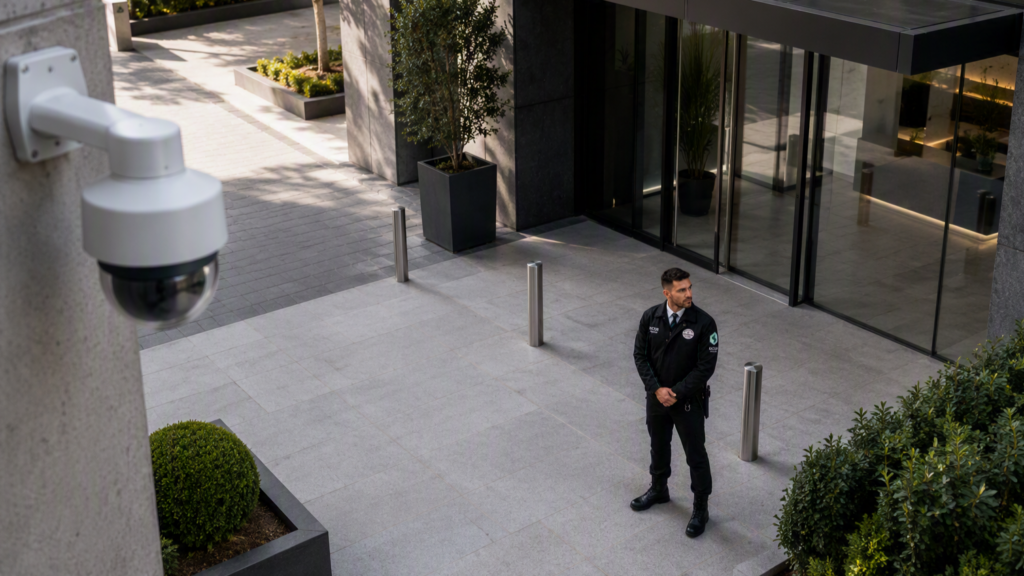
Comprehensive security for businesses: a protection model that combines on-site security personnel, electronic security systems, monitoring, and response procedures to provide coordinated protection for an organization's people, facilities, and assets.
What is comprehensive security?
Comprehensive security is a protection model that combines people, technology, processes, and planning to develop security strategies for companies that can prevent risks and protect an organization in a coordinated manner. Unlike traditional approaches, which typically address each security need independently, comprehensive security seeks to bring together all available resources within a single strategy.
This approach is based on a simple idea: no single security measure can provide complete protection on its own. Although a video surveillance system can help detect incidents, it requires response procedures and trained personnel to manage them. Similarly, on-site surveillance is much more effective when supported by technological tools that facilitate the monitoring of facilities and the early detection of potential threats.
Law 5/2014 on Private Security recognizes various activities that contribute to the protection of people, property, and facilities, including on-site surveillance and protection, the installation and maintenance of security systems, video surveillance, and alarm management. All of these are part of what we now understand as a comprehensive security strategy.
In practice, a comprehensive security solution may include services such as:
- Facility Security and Protection
- Access and Visitor Control
- Video Surveillance Systems
- Alarm and Intrusion Systems
- Incident Monitoring and Management
- Alarm Monitoring Stations (AMS)
- Operational Procedures and Risk Management
The combination of these elements makes it possible to anticipate potential incidents, improve the organization’s ability to respond to critical situations, and strengthen the protection of people, assets, and the organization’s operations.
More than just a collection of independent measures, comprehensive security represents a holistic approach to corporate protection, in which each resource fulfills a specific function and contributes to a single goal: ensuring environments that are safer, more resilient, and better prepared to face today's risks.
Why is it important to take a comprehensive approach to security?
The risks organizations face are becoming increasingly diverse and complex. From unauthorized access and theft to acts of vandalism, operational incidents, and emergencies, these threats can affect people as well as facilities, assets, and business continuity.
Furthermore, in an increasingly digitized and connected environment, security is no longer limited solely to physical spaces. Much of companies’ critical information, operational processes, and management systems rely on interconnected technologies, meaning that any incident can have both physical and digital consequences. The security of facilities, people, and information has thus become an increasingly interconnected challenge.
For this reason, many companies have moved away from security models based on isolated measures toward comprehensive security strategies that combine surveillance, technology, and response procedures. This approach allows them to address risks in a coordinated manner and improve their ability to prevent, detect, and respond to potential incidents.
Greater capacity for prevention
One of the main benefits of comprehensive security is its ability to anticipate risks before they turn into incidents.
The combination of on-site monitoring, technological systems, and response protocols makes it possible to identify abnormal situations, detect vulnerabilities, and implement preventive measures more effectively. In this way, organizations can reduce the likelihood of incidents that compromise the safety of people or the operations of their facilities.
Furthermore, the Private Security Act itself recognizes private security as a tool for anticipating and preventing potential risks, dangers, or crimes, thereby reinforcing its role in the overall protection of businesses and institutions.
Protection of People and Assets
Comprehensive security is not limited to protecting buildings or infrastructure. Its goal is to provide comprehensive protection that encompasses all the essential elements required for carrying out a business activity.
This includes the safety of employees, customers, and visitors, as well as the protection of facilities, equipment, merchandise, documentation, and valuable information. By integrating various security measures into a single strategy, it is possible to establish levels of protection tailored to the specific needs of each organization.
Improving Incident Response
Although prevention is essential, no organization is completely immune to incidents.
For this reason, responsiveness is another pillar of comprehensive security. Coordination among security professionals, monitoring systems, video surveillance, and operational protocols enables a faster and more effective response when a situation arises that requires intervention.
This capability can help minimize the impact of an incident, reduce damage, and restore normal operations as quickly as possible.
Business Continuity
Security also plays an important role in business continuity. A disruption caused by a security incident can result in financial losses, reputational damage, and operational difficulties.
A comprehensive security strategy helps identify risks, protect the organization's critical resources, and establish response mechanisms that ensure business operations can proceed with greater assurance.
For this reason, more and more companies view security not only as a protective measure, but also as an investment aimed at preserving their long-term stability, competitiveness, and operational capacity.
The Pillars of a Comprehensive Security Strategy for Businesses
An effective comprehensive security strategy is based on a combination of different measures, resources, and procedures that work together in a coordinated manner to protect an organization’s people, facilities, and assets. Rather than implementing isolated solutions, this approach ensures that every security element contributes to a common goal: preventing risks, minimizing the impact of incidents, and ensuring business continuity.
On-site Security and Protection
On-site security continues to be one of the cornerstones of comprehensive security. The presence of trained professionals makes it possible to monitor facilities, manage potential risks, and respond immediately to incidents or emergencies.
Law 5/2014 on Private Security defines the surveillance and protection of property, establishments, locations, and events—as well as the people who may be present there—as one of the primary activities of private security.
In addition to its ability to intervene, on-site surveillance plays an important preventive and deterrent role, helping to reduce inappropriate behavior, unauthorized access, or potential criminal acts. Its effectiveness increases when it is integrated with other security systems and supported by clearly defined procedures.
Electronic Security Systems
Technology has become an essential component of any modern security strategy. Electronic security systems enable the early detection of risks, real-time monitoring of facilities, and an enhanced ability to respond to potential incidents.
Some of the most common solutions include:
- Alarm and Intrusion Systems
- Video Surveillance Systems
- Access control
- Detection Sensors
- Integrated Security Monitoring and Management Systems
Private security regulations expressly provide that the installation and maintenance of security systems, as well as video surveillance and alarm management services, are activities that must be carried out by duly authorized companies.
The main advantage of these technologies is their ability to provide continuous monitoring and generate information that facilitates decision-making and incident management.
Control and Monitoring
The ability to continuously monitor what is happening at a facility is essential for anticipating risks and responding quickly to any incident.
Control centers and Alarm Receiving Centers (ARCs) play a key role in this area, as they are responsible for receiving, verifying, and managing signals from various security systems. Spanish law recognizes alarm management as a specific private security activity and establishes the conditions for its provision.
Continuous monitoring makes it possible to detect abnormal situations, verify events, activate response protocols, and coordinate the necessary resources to respond effectively. As a result, organizations can significantly improve their response times and strengthen the protection of their facilities and assets.
Procedures and Risk Management
Technology and human resources are essential, but their effectiveness depends largely on the existence of appropriate procedures and sound risk management.
Any comprehensive security strategy must begin with an analysis that identifies threats, vulnerabilities, and specific protection needs. Based on this assessment, it is possible to design measures tailored to each organization and establish clear protocols for incident prevention and management.
The Private Security Act itself emphasizes the preventive nature of security as a tool for anticipating potential risks and reducing their impact. Similarly, organizations such as INCIBE underscore the importance of establishing controls, procedures, and oversight mechanisms that protect assets and ensure an effective response to incidents.
When on-site security, technology, monitoring, and procedures work in coordination, organizations have much stronger, more efficient protection that is tailored to the actual risks they face.
Which companies and organizations need comprehensive security?
Comprehensive security is not a need exclusive to large corporations or critical infrastructure. Any organization that needs to protect people, facilities, goods, equipment, or information can benefit from a security approach that combines human resources, technology, and operational procedures.
The reality is that risks vary depending on the type of activity carried out, the size of the facilities, the number of people who access them, and the value of the assets to be protected. For this reason, comprehensive security solutions must be tailored to the specific needs of each environment.
Among the organizations that routinely implement comprehensive security strategies are:
- Corporate buildings and offices, where it is essential to control access, protect employees and visitors, and ensure business continuity.
- Logistics centers and warehouses, which need to protect goods, control incoming and outgoing shipments, and monitor large areas.
- Industrial facilities, where protecting processes, machinery, and infrastructure is essential to prevent disruptions to operations.
- Shopping centers and retail stores that need to prevent losses, protect customers and employees, and manage large crowds.
- Hospitals and healthcare facilities, where safety, accessibility, and the protection of sensitive areas must all be balanced.
- Educational institutions, which must ensure safe environments for students, teachers, and administrative staff.
- Critical infrastructure and strategic sites, whose operations require particularly rigorous security measures.
Comprehensive security solutions for businesses can be tailored to a wide range of industries, as each industry has its own specific risks, operational needs, and security requirements.
Physical Security and Electronic Security: Why They Must Work Together
For years, many organizations approached security as a set of independent measures. However, evolving risks and technology have shown that the most effective protection is achieved when physical and electronic security work in coordination.
On the one hand, physical security provides a visible presence, the ability to intervene, and professional judgment. Security guards can monitor facilities, manage incidents, conduct inspections, and take immediate action in situations that require a human response.
In addition, electronic security provides continuous monitoring of facilities through tools such as video surveillance, alarm systems, access controls, and monitoring centers. These solutions enable the early detection of incidents, the collection of information, and the generation of real-time alerts.
The combination of these two areas offers significant advantages:
- Greater capacity for prevention and deterrence.
- Faster incident detection.
- Better coordination of the response.
- Continuous monitoring of the facilities.
- Optimization of human and technological resources.
- Greater control over access, movements, and activities.
For example, a video surveillance system can detect an unusual situation, while a security professional can verify it, assess the risk, and activate the appropriate response protocol. In this way, technology and people work together to provide more effective protection.
For this reason, the most advanced comprehensive security strategies do not view physical and electronic security as separate solutions, but rather as components of a single strategy aimed at the organization’s overall protection.
The current trend in corporate security is to integrate both areas into a single strategy. This allows companies to gain a more comprehensive view of risks, optimize resources, and improve their ability to prevent and respond to incidents.
Comprehensive Security Solutions for Businesses: Grupo SICOR's Proposal
Implementing a comprehensive security strategy requires a preliminary analysis of each organization's needs, as well as the ability to coordinate various resources and solutions within a single protection model.
In this context, Grupo SICOR develops comprehensive security solutions for companies, organizations, and institutions, combining on-site surveillance, electronic security systems, monitoring, and operational procedures designed to protect people, facilities, and assets.
With more than 20 years of experience in the industry, the company offers a comprehensive approach that enables it to design customized security strategies for various environments and sectors. These solutions may include services such as on-site security and protection, intrusion detection systems, video surveillance systems, access control, monitoring, and other resources designed to enhance organizational security.
In addition, Grupo SICOR is part of El Corte Inglés, one of Spain’s most well-known business groups, and holds the necessary authorization to carry out private security activities.
Thanks to a combination of specialized professionals, advanced technology, and a comprehensive approach to security, Grupo SICOR helps organizations anticipate risks, improve their response capabilities, and create safer environments for people, facilities, and assets.
Frequently Asked Questions About Comprehensive Security
What is comprehensive security?
Comprehensive security is a protection model that combines human resources, technology, monitoring, and response procedures to prevent risks and provide coordinated protection for an organization’s people, facilities, and assets. This approach integrates various security measures into a single strategy, thereby improving prevention, detection, and response to potential incidents.
What is the difference between comprehensive security and traditional security?
The main difference lies in the approach. Traditional security is typically based on standalone measures, such as hiring security guards or installing cameras, whereas comprehensive security coordinates all security resources within a single strategy. In this way, on-site security, technological systems, monitoring, and response protocols work together to provide more comprehensive and effective protection against risks.
What services are included in a comprehensive security solution?
A comprehensive security solution may include on-site surveillance and protection, access control, video surveillance systems, alarm and intrusion detection systems, alarm management through Alarm Monitoring Centers (AMCs), remote monitoring, and risk management procedures. The combination of these services enables organizations to prevent incidents, improve their response capabilities, and tailor security measures to the specific characteristics of each facility or activity.
Is comprehensive security only for large companies?
No. Comprehensive security can be applied to organizations of any size. Offices, logistics centers, retail stores, industrial facilities, educational institutions, and healthcare facilities can all benefit from a security strategy tailored to their specific risks and needs. The goal is not to implement as many measures as possible, but rather to design a solution that is proportionate to the level of risk and the characteristics of each organization.
Why combine physical security and electronic security?
Because the two complement each other and deliver better results when they work in coordination. Physical security provides the ability to monitor, intervene, and respond through trained professionals, while electronic security enables the detection of incidents, real-time monitoring of facilities, and the generation of alerts through video surveillance systems, alarms, or access control. The integration of both areas improves prevention, speeds up incident response, and provides a more comprehensive view of the organization’s security.
How do you implement a comprehensive security strategy?
The implementation of a comprehensive security strategy typically begins with a risk analysis to identify threats, vulnerabilities, and protection needs. Based on this assessment, the most appropriate security measures are designed, combining human resources, technology, and operational procedures. These solutions must then be monitored and updated periodically to ensure that they continue to address the organization’s risks and needs.