

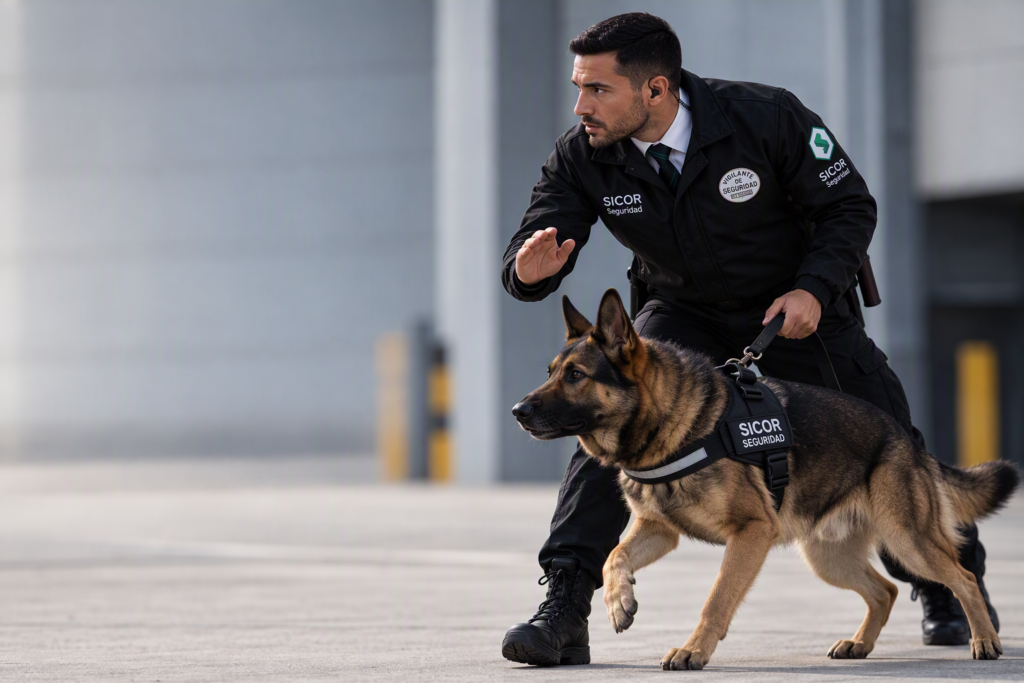
A K-9 unit is not simply a dog accompanying a security guard. It is a team trained to work in a coordinated manner, in which each member fulfills a specific role: the professional directs the operation, assesses the situation, and makes decisions; the dog provides sensory capabilities, mobility, and a presence that serves as a significant deterrent.
This team is known as a canine team. Its effectiveness depends both on the animal's training and on the relationship it builds with its handler.
Behind every patrol, preventive inspection, or assignment at a major event lie many hours of selection, socialization, training, and teamwork. There are also rules, protocols , and a very clear responsibility: the dog complements the security guard but never replaces him.
What exactly is a private security K-9 unit?
A canine unit consists of one or more teams, each comprising a working dog and its handler.
When performing duties related to private security, such as surveillance or the protection of facilities, the guide must be a licensed security guard. The security guard is the one who directs the operation and performs the duties established by regulation.
The dog, therefore, does not work independently nor does it possess its own abilities. It is a specialized assistive device, just as certain communication systems, vehicles, or control tools can be.
Spanish regulations expressly provide for the use of dogs in security services. Article 75 of the Private Security Regulations stipulates, among other requirements, that dogs must be properly trained and identified, comply with health regulations, and be handled by security guards with experience in their care and use. The service must also be organized in a way that avoids unnecessary risks to people.
To put it simply: it's not enough to just have a good dog. You need an animal that's trained for the job, a qualified professional, joint training, and an operational approach tailored to the environment.
The canine duo: two members, one team
The concept of a partnership helps us understand why the relationship between a dog and its handler is so important.
During a patrol, the security guard observes the surroundings, directs the dog, interprets its behavior, and decides how to act. The dog, for its part, responds to the commands it has learned and uses its skills according to its specialization.
This coordination doesn't happen overnight. The handler needs to know how their dog normally behaves: when it's focused, when it's distracted, if it's tired, or if there's been a change in its usual response.
The dog must also receive clear and consistent cues from its handler. A consistent approach makes it easier for the dog to understand what is expected of it at all times.
That is why the best results do not come solely from individual training. They arise from the trust, practice, and mutual understanding that develop over time.
Not all dogs are suited for every job
There is no single race or profile that is suitable for every service.
The selection process takes into account factors such as personality, stability, learning ability, motivation, sociability, physical fitness, and suitability for the intended role.
A dog that works in a public setting must be able to handle a wide variety of stimuli with confidence: vehicles, noises, surfaces, unexpected movements, or crowds of people. In detection work, it must also be able to maintain focus and conduct a search in an orderly manner.
This explains why preparation begins long before a specific task is taught.
From Socialization to Specialization
The process is usually carried out in stages:
- Selection and socialization. We assess the dog's temperament and gradually acclimate it to different people, sounds, and environments.
- Obedience. Learn to respond to basic commands for position, stay, recall, and following the handler.
- Acclimatization to the work environment. Trainees become familiar with situations similar to those they will encounter on the job.
- Specialization. Training is geared toward the intended function, such as assisting with surveillance or detecting specific odors.
- Joint training. The dog and its handler practice as a team to improve their communication and coordination.
The specialized training for security guards who work with dogs includes topics related to training and obedience, safe handling, security dogs, explosive detection, basic care, health documentation, first aid, and collaboration with law enforcement agencies.
Working out just once isn't enough
Initial training is just the starting point.
A working dog needs to practice regularly to maintain obedience, concentration, and learned responses. The handler must also refresh their knowledge and ensure that communication between the two remains precise.
This training allows us to detect possible changes in the animal’s behavior, motivation, or physical condition. It also helps prepare the handler-dog team for different scenarios, ensuring that their performance does not depend solely on situations they are all too familiar with.
Grupo SICOR's corporate materials emphasize precisely this idea: recycling and training must be ongoing.
What kinds of jobs can they do?
The functions depend on the type of service, the environment, the dog's specialization, and the applicable regulations. However, two broad categories can be distinguished: security and response, and preventive detection.
Security, Surveillance, and Response
In this context, the dog accompanies the security guard and enhances his or her operational capabilities.
It can be used, for example, to patrol business facilities, parking lots, large compounds, outdoor areas, or high-traffic spaces.
Their mobility allows the team to patrol and monitor large areas. Their presence can also serve as a deterrent, especially in services where the visibility of the device is part of the prevention strategy.
This does not mean that the dog decides when to intervene. The security guard maintains control of the operation at all times and must act in accordance with the applicable principles and protocols.
Preventive screening
Sniffer dogs are trained to recognize specific scents and alert their handler to a possible location.
It is important to fully understand what that response means: the dog’s signal is an indication that must be interpreted and handled in accordance with a protocol. It is not standalone evidence, nor does it, on its own, establish criminal conduct.
In private security, these types of teams can assist with preventive checks in predefined areas. If there is any indication of explosives, narcotics, or other controlled substances, the security guard must act within the scope of their authority and request the intervention of law enforcement agencies when appropriate.
Nor should these units be confused with those of the National Police or the Civil Guard. Although they may use similar principles of canine training, their responsibilities and protocols are not the same.
Where do they add the most value?
Canine units can be integrated into various security systems:
- Commercial and industrial facilities.
- Logistics centers and warehouses.
- Perimeters and parking lots.
- Shopping centers and large venues.
- Concerts, fairs, shows, and sporting events.
- Transportation infrastructure.
- Airport environments, when specific requirements are met.
The key is not to incorporate a dog simply because it makes for an eye-catching image, but rather to determine what need it should fulfill, what specialization it requires, and how it will coordinate with the rest of the unit.
A K-9 unit is most effective when it is part of a comprehensive strategy that includes on-site surveillance, operational personnel, communication procedures, and, when appropriate, technological systems working in a coordinated manner.
Well-being is also part of safety
A dog that is tired, stressed, or in physical discomfort cannot work as reliably. That is why well-being is not a secondary concern: it is an integral part of the quality and safety of the service.
Day-to-day management must take into account issues such as:
- Adequate water and food.
- Rest and recovery.
- Veterinary follow-up.
- Hygiene and exercise.
- Identification and medical records.
- Safe transportation.
- Adapting work to temperature and environmental conditions.
The handler plays a crucial role here. He or she observes the animal before, during, and after the task and must identify any signs that indicate the activity should be scaled back or stopped.
The SICOR Group's K-9 Unit
At Grupo SICOR, we have a specialized K-9 Unit that reinforces our security services and expands the scope of our security guards’ operations. The combination of our professionals’ experience and the dogs’ abilities allows us to offer a more comprehensive, proactive response tailored to the needs of each environment.
We have response-oriented security units and specialized detection units focused on the prevention of explosives and narcotics, prepared to provide services at business and airport facilities, as well as at shows and events.
The effectiveness of our K-9 Unit is based on the training of each dog-handler team. That is why we carefully select our teams and continuously work on training, coordination, and trust between the dog and its handler. This ongoing training allows us to maintain a high level of responsiveness while ensuring the animal’s care and well-being.
In this way, we have integrated the K-9 Unit as a specialized resource within our security operations, providing greater capabilities for prevention, detection, response, and deterrence wherever the service requires it.
In addition, in the field of explosives detection, our teams are accredited annually, and we work in collaboration with AESA and the National Police Canine Unit, strengthening the training and expertise needed to operate in particularly demanding environments.
A collaborative effort that begins long before the service
Canine units stand out because of the presence of the dog. However, their true value lies in everything that isn't immediately apparent: selection, training, security guard training, joint exercises, protocols, and daily care.
The dog brings exceptional abilities to the table, but it is the professional who leads, interprets, and makes decisions. It is this combination that makes them a team.
When there is proper training, coordination, and respect for the animal’s well-being, the K-9 unit is no longer merely a deterrent. It becomes a specialized resource capable of strengthening prevention, surveillance, and response as part of a security system tailored to each environment.